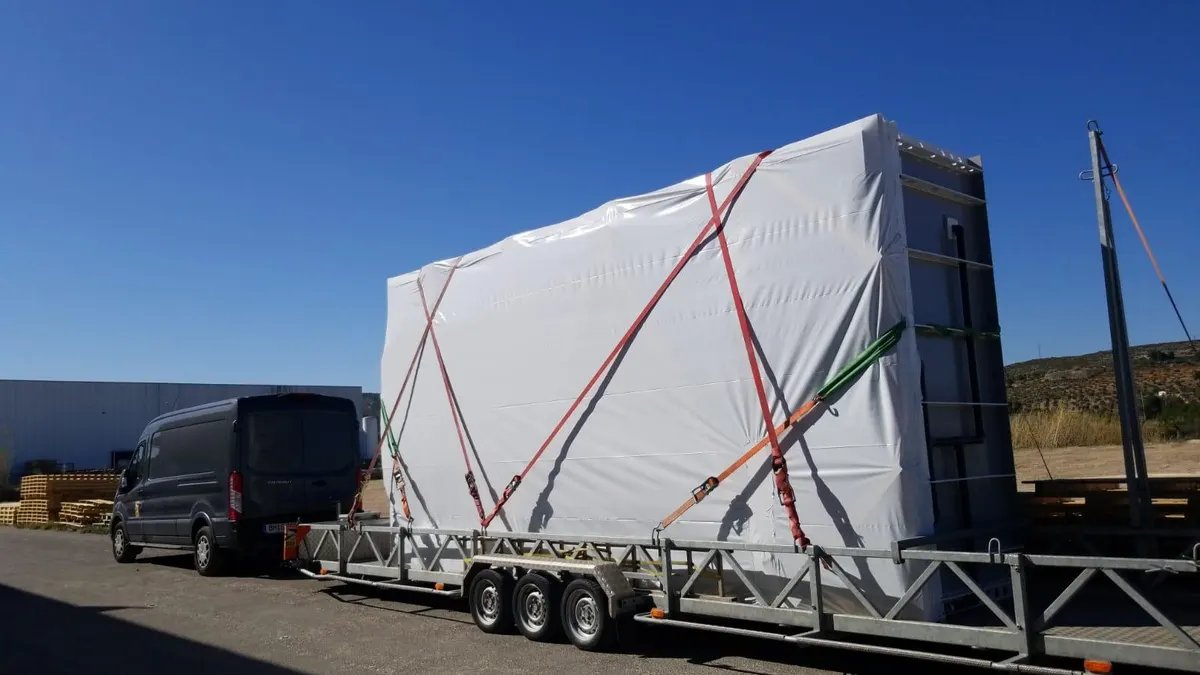
The ATA Carnet is the international customs pass for temporary export: exhibition equipment, machines for demonstrations, professional equipment or product samples travel abroad with it without import duties – the prerequisite is re-export within twelve months. For the Munich–Moscow route, the carnet was long the standard procedure for trade fair and demo shipments. Since 2022, however, the situation in the non-EU business has changed fundamentally.
EU sanctions regulations 833/2014 and 269/2014 massively restrict the movement of goods with Russia. Anyone who wants to bring equipment to Moscow today must first clarify one question: may these goods even still be exported? Speed Logistics checks every enquiry against the current sanctions situation before acceptance – and only takes on shipments that are demonstrably permitted.
What the EU sanctions specifically mean
Regulation (EU) 833/2014 prohibits the export of entire product groups to Russia: dual-use goods, large parts of electronics and high-tech, many machines and industrial goods as well as luxury goods. It is precisely typical carnet goods – trade fair exhibits with electronics, test devices, demonstration machines – that therefore often fall under an export ban, even if the goods are only intended to enter the country temporarily. In parallel, Regulation 269/2014 prohibits any provision of economic goods to listed persons and companies. A serious check therefore always comprises three levels:
- Goods check: comparison of the customs tariff numbers with the annexes of Regulation 833/2014 and the dual-use regulation
- Consignee check: screening of the trade fair organiser, consignee and end recipient against the EU sanctions lists
- End-use and circumvention check: plausibility of the intended use and re-export, because circumventing sanctions is also prohibited
Added to this are Russian countermeasures that can change at short notice – for example import restrictions or additional documentation obligations at the border. Anyone loading here without a current legal check risks not only seized goods but also criminal and administrative-fine consequences for their own company. Responsibility lies with the exporter – an experienced forwarder takes on the checking work, not the responsibility. Comparable rules apply, incidentally, to Belarus: here too there are extensive EU goods bans and personal listings that must be checked before every shipment. Anyone merely planning Belarus as a transit country is subject to the same due-diligence obligations as with direct shipping.
How a permitted shipment to Moscow works
If the check is positive – for example with non-listed goods for civilian purposes – the transport remains organisationally demanding. Russian and Belarusian carriers are not allowed to drive in the EU, and conversely Russia generally does not let EU trucks into the country. In practice, the goods are therefore transhipped onto approved vehicles at the EU external border. Speed Logistics organises the chain end-to-end: collection in Munich, export declaration, carnet handling, border transhipment and delivery – on request directly to Moscow trade fair venues such as Crocus Expo or the Expocentre. With the ATA Carnet itself, it should be noted that the Chambers of Industry and Commerce currently issue carnets for Russia only after a case-by-case check; the re-export risk should be realistically assessed. In terms of time, noticeably longer transit times than earlier direct runs must be expected, as sanctions checking, border transhipment and more intensive customs controls take time. In terms of price, reusable-equipment shipments move – depending on route, checking effort and lead time – in the guide range of €3,500–7,000.
For the handling, the following documents should be available early:
- A complete goods list with customs tariff numbers, serial numbers and goods values
- Details of the consignee, organiser and planned use in the destination country
- Proof of the return-transport date for re-export within the carnet period
Alternatives: trade fairs outside Russia
Many companies now switch to trade fair venues that can be reached without sanctions risk – for example in Türkiye, the Gulf, the Caucasus or Central Asia. The ATA Carnet also works in some of these countries; where it does not, customs procedures for temporary use are applied. Important: even with shipments to Central Asia or the Caucasus, we check the end recipient and end use in order to rule out any sanctions circumvention. Anyone planning a temporary export should provide the goods list and consignee data early – then it can be said quickly and reliably what is permitted and what is not. Our principle here is uncomfortable but honest: better to decline an enquiry than to accept a shipment that later brings the customer into an investigation.